
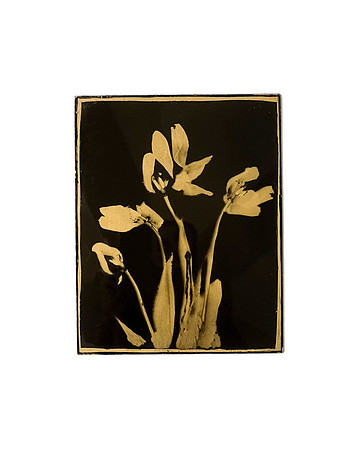

Orotones (sometimes called gold-tones or Curt-Tones) are a photographic process made popular in the late 1800's by Edward Curtis. Silver gelatin positive images on clear glass are backed with a gold substance to give the image a glistening, almost 3D quality. Curtis describes the process as follows: "The ordinary photographic print, however good, lacks depth and transparency...but in the Curt-Tones, all the transparency is retained and they are as full of life and sparkle as an opal". I use liquid emulsion to hand coat watercolor paper and expose each print in the darkroom, like an ordinary silver gelatin print. After the development process, I do an emulsion transfer, similar to a Polaroid emulsion lift, onto clear glass. After it is dried, the emulsion side of the glass is coated with gilder's wax or gold leaf. Because everything in this process is done by hand, no two prints are ever the same and no one is ever perfect.
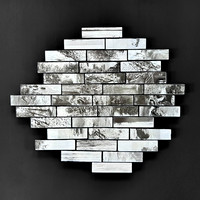
These collages consist of several orotones from each frame of a roll of medium format film. I print a small image of each frame using liquid emulsion (as described above). Each image is then cut into two or three slivers and then transferred onto small pieces of glass, backed with gilder's wax and assembled to form the collage. This ongoing series is based on memories of one day or one outing using one roll of film. We remember slivers of our days and our minds often put those fragments together to form a new narrative. These collages are mounted onto large black tray frames.
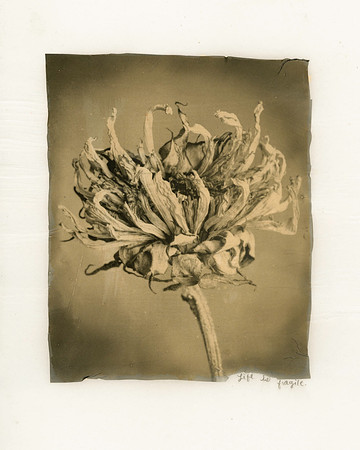
In 2021, my photography group, Fleeting Moments Artists, worked on a year-long project of writing text to go along with our images. I was experimenting with liquid emulsion prints on vellum at the same time and decided to combine the two. For this series I call Aging, I photographed aging botanicals, and printed them using liquid light. I then did an emulsion transfer, similar to a Polaroid emulsion lift, onto vellum paper. Since the emulsion is fragile, slippery and flexible, I was able to intentionally distress, rip and wrinkle the emulsion to go along with the Aging theme. The image is then backed with faux gold leaf, which shows through the translucent vellum. The words I chose for each image reflect my thoughts at the time of composition.
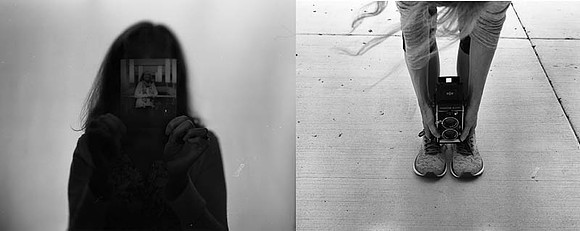
This series was made for my final project for a large format photography class taken at College of DuPage in the spring of 2019. Everyone, or most of us anyway, have something in our lives that we hold on to that puts us in shadow. I asked friends and relatives, all women, to bring an item to be photographed with, that represents what puts them in shadow - something that holds them back, brings them down, keeps them in the dark. The idea was to focus on their hands and what they are holding on to. In contrast, I then photographed their hands doing what brings them into the light - doing what brings them joy. Another title for this series is "Think, Instead, Of The Light That Is Inside You".
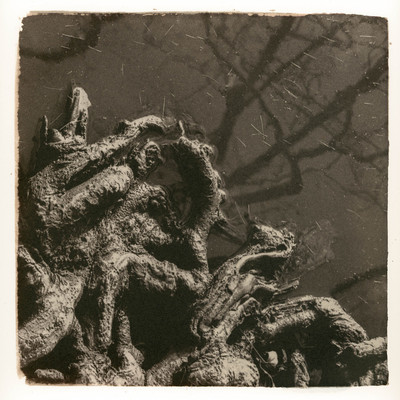
In The Four Elements series, I am taking a contemplative walk through nature, seeing the four elements and capturing those moments in order to honor the beauty of and connectedness of nature. We encounter the four elements in nature, but also in our lives. We can appreciate their role in the natural world, but also how they correspond to the seasons of our lives, our creativity and specifically, our photography.
The four elements, earth, air, water and fire, are the basis of all creation in the natural world and all around us. We experience the wind as it moves through the trees, leaves and grass. We see birds in flight and feel the air as we take in a breath, which gives us life and inspiration. The sun reflecting on the water or shining through leaves makes us think of warmth or heat, what sets us on fire, what we’re passionate about. Most of the earth and most of our bodies are made up of water, which can be calming and cleansing. The tides of the oceans ebb and flow like the rhythms of our life. We walk on the mud, soil, roots and plants of the earth and think of what keeps us grounded and where our roots are.
Taking a long, loving look at nature makes it easy to see all four elements at work with each other, how each one builds on and depends on another. This allows me to slow down, notice and appreciate the created world right in front of me. I can then create through photography, and honor these elements in the natural world. The elements inspire us to use our creativity to photograph the elements! I chose to print these images as salted paper prints, an alternative photographic process that uses salt, silver and UV light, because all of the four elements are present during this exposure and printing process. Earth (paper), Sun (exposure) Water (wash), and Air (drying) were used to produce these prints.
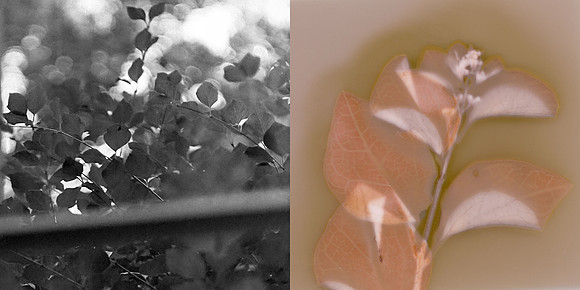
As part of a photography class called The Art of Seeing, at the College of DuPage, we were asked to emulate a photographer or artist. Photographer Uta Barth’s images deal primarily with perception and how we see. Using space, backgrounds, and what is seen in the periphery, she shifts the viewer’s attention to what is incidental to emphasize its importance. She photographs where her eyes wander. She does not assign a narrative or meaning to her images and wants the viewer to only see the image, not interpret it. We concentrate on the act of seeing, instead of what we are looking at. We see a series of elements in a familiar space, and while they may not seem important, they remain in our mind’s eye. Like Uta Barth, I like to photograph wherever I happen to be. She says that if we are interested in how we see, there’s no need to go any further than your own home. I love to focus on the mundane and make photographs of elements that normally go unseen. In Barth’s series Untitled 2005 and 2006, she photographed flowers in vases in her home, and their “after images”, those images you see afterwards, when you close your eyes. These images reminded me of lumen prints and inspired this series of photographs. I captured everyday moments in my home, where my eyes happened to land, and then paired them with a lumen print made with the actual plant or flower in the image, giving the viewer another way of seeing the content of the image. Making the lumen print allowed me to see what else the scene is capable of giving us and what it leaves behind for us to view. It is my version of an “after image”. I used 120 film to make both images, to emphasize two different ways of seeing the object using the same medium. Putting the images on double panels also allows for a shift in perception and perspective; two different ways of seeing. For me, these images are a way of slowing down, noticing what there is around me and seeing what else is there.
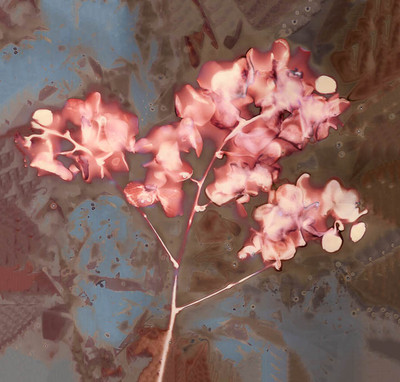 Lumens is a series of photographic images created without the use of a camera. They are photograms of organic and inorganic materials placed onto black and white photo paper. The images are exposed using UV light and are dependent on exposure time, heat, humidity and the combination of the organic materials and the type of sensitized paper. The plant materials generate their own color when combined with the chemicals in the paper. Each image is unique and I love that you never know what will emerge on the paper after the exposure. Because the image is very textural when it is created, I try to bring back some of that texture in the presentation by digitally printing a scanned or photographed image of the original lumen print onto dupioni silk and then attaching it to a wooden panel.